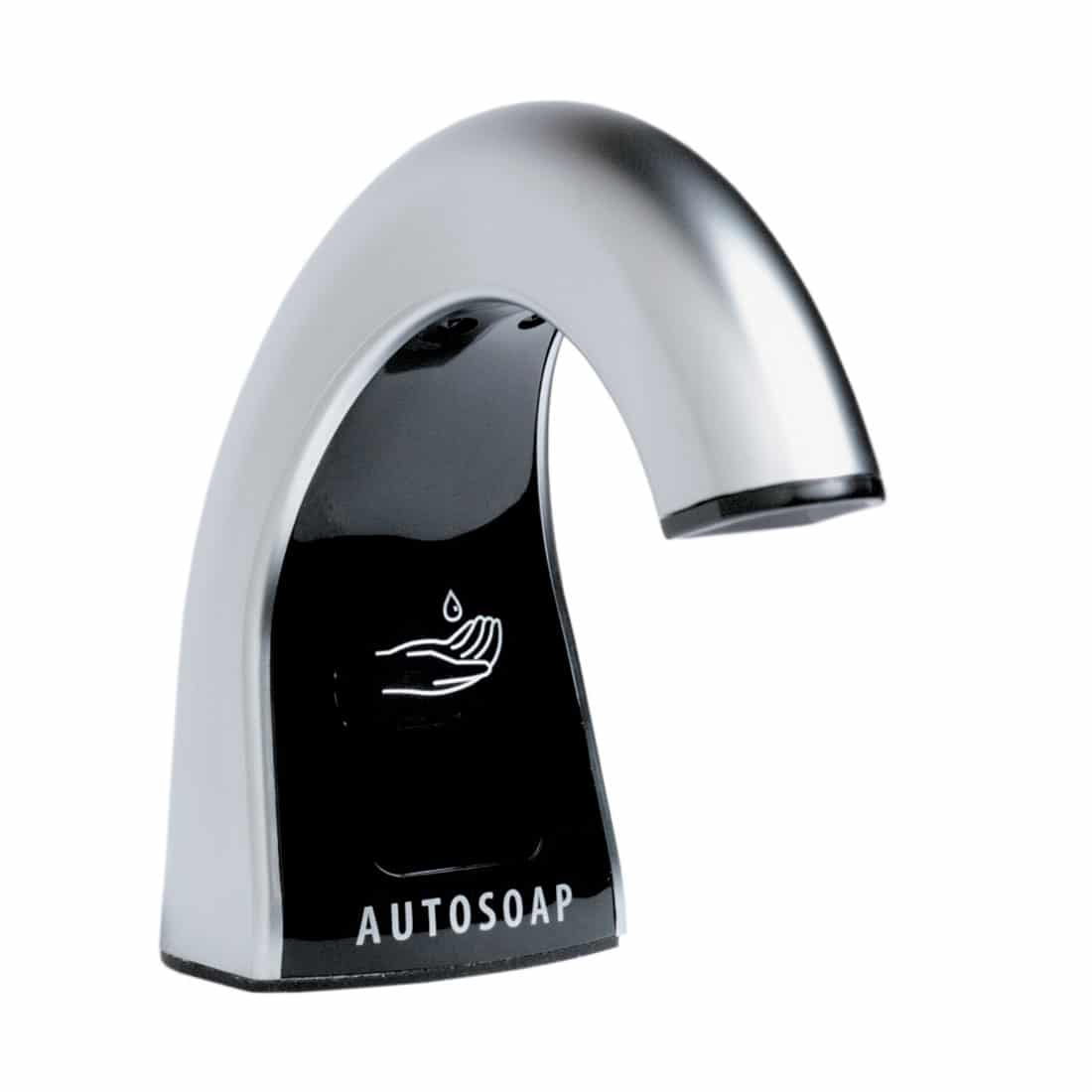
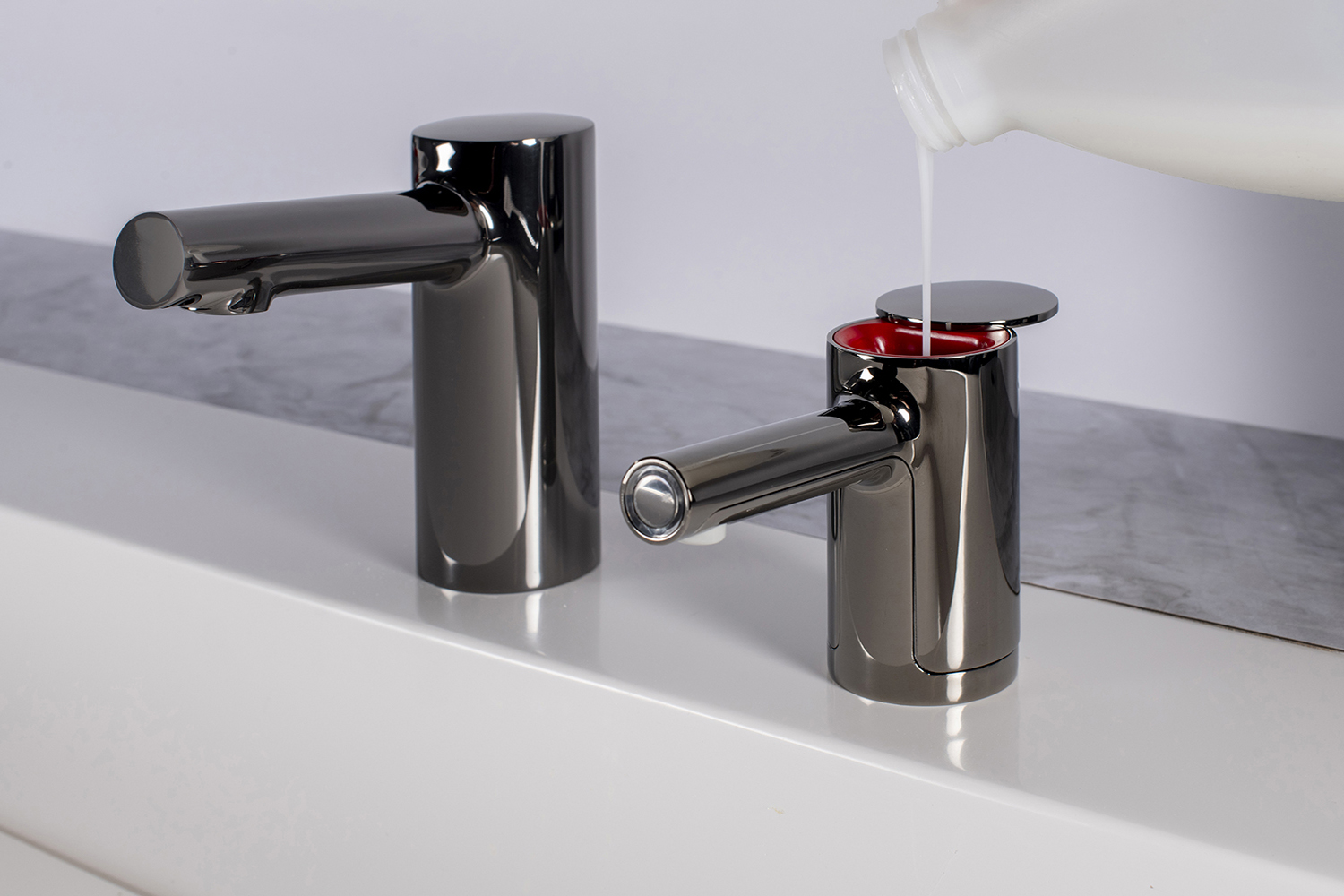
Clean aerators every 3 to 6 months in hard water areas and every 6 to 12 months on softened or low-mineral supply. Sensor soap dispensers on the same water line and in the same restroom foot traffic should go on that identical inspection sheet, because the mineral scale that chokes an aerator screen is the same scale that fogs a sensor lens or narrows a nozzle orifice. Treating them as separate trades (plumbing versus electrical/fixtures) is why one gets serviced and the other gets replaced early.
Why Aerators And Dispensers Foul Together
Aerators and sensor dispensers share three things: they sit at the point of use, they see the same water hardness, and they have small orifices that concentrate whatever is dissolved in that water. An aerator screen has openings measured in fractions of a millimeter to mix air into the stream. A soap dispenser nozzle is similarly narrow to control droplet size and prevent drips. Calcium and magnesium carbonate drop out of solution at these constriction points as water evaporates or splashes, building a crust that narrows the passage further over time.
The dispenser adds a second failure path the aerator doesn’t have: the sensor window. Airborne mineral dust, soap aerosol, and hand lotion residue settle on the IR emitter and receiver just as they would on any other lens in the room. A facility running both fixtures on the same wall is running two scale-sensitive components on one water and air supply, which is the practical case for one shared audit.
Standard Thread Sizes And Flow Rates
US faucet aerators come in two thread standards, and knowing which one you have determines whether you’re ordering a replacement or a dead-end part. Male thread is 15/16-27, meaning the aerator threads onto the outside of the spout. Female thread is 55/64-27, meaning the aerator threads inside the spout opening. Some spouts use adapters to convert between the two, so measure before ordering in bulk.
Flow rate is the other spec that matters for both water budgeting and complaint tickets. Common aerator ratings are 1.5 GPM, 1.0 GPM, and 0.5 GPM, with lower ratings used in high-traffic restrooms to cut water use without a noticeable drop in usability for handwashing. A facility standardizing across floors should pick one flow rate per fixture type and stock it, rather than letting each replacement default to whatever the plumber has on the truck.
Flow Rate
Typical Use Case
Notes
1.5 GPM
Kitchens, break rooms
Faster fill for pots and containers
1.0 GPM
General restroom lavatories
Common facility default
0.5 GPM
High-traffic public restrooms
Lowest water draw, still functional for handwashing
Cleaning Steps Without Damaging Screens
Aerator screens are thin brass or plastic mesh and they distort easily under a wire brush or a screwdriver tip. The safe sequence is: unscrew the aerator by hand or with a strap wrench (not pliers, which crush the housing), separate the screen and washer layers, and soak the parts in a descaling solution rather than scraping them. A soft toothbrush after soaking clears loosened deposits without deforming the mesh. Reassemble in the same order the parts came apart, since screen and flow-restrictor discs are stacked in a specific sequence and reversing them changes the spray pattern or flow rate.
Photograph the disassembled parts before cleaning if this is the first service cycle on that fixture type, so techs have a reference for reassembly order.
Do not use metal picks or wire brushes on the mesh screen.
Replace the rubber washer if it’s compressed or cracked rather than reusing it indefinitely.
If soaking doesn’t fully clear the screen, replace it. A screen that’s been scaled twice is more likely to scale again quickly.
Mineral Buildup’s Effect On Sensor Range
Most IR-based sensor dispensers and sensor faucets are tuned to detect a hand at roughly 4 to 6 inches from the sensor window. That range is calibrated at installation for a clean lens and an unobstructed emitter. A film of hard water spot, soap residue, or dust reduces the effective signal strength, which shows up operationally as the dispenser requiring a hand to be closer than spec, or missing detection intermittently, before it fails outright. This is the same drift pattern maintenance teams see on commercial sensor faucets in high-traffic restrooms, where lens fouling produces gradual range loss rather than a clean on/off failure.
Because the failure is gradual, it’s easy to misattribute to a battery or solenoid problem when the real cause is a dirty lens. Wiping the sensor window with a soft, lint-free cloth and, if needed, a small amount of isopropyl alcohol restores range without touching the electronics. This should be a weekly or biweekly task in high-traffic restrooms, not an annual one, because lens fouling from soap aerosol happens faster than mineral scale inside the nozzle itself.
Replacement Signals Facility Teams Should Track
Cleaning restores function up to a point. Past that point, replacement is cheaper than repeated service calls. The signals differ slightly between the two fixture types but the underlying driver, accumulated mineral load, is the same.
Aerator: flow rate drops noticeably despite cleaning, spray pattern becomes uneven or splashes outside the basin, or the housing threads are stripped from repeated wrench use.
Sensor dispenser nozzle: dispensing volume becomes inconsistent, drips persist after cleaning, or the pump motor runs longer than normal to push soap through a narrowed orifice.
Sensor window/electronics: detection range stays short after cleaning, false triggers increase, or battery life drops sharply from the sensor working harder to compensate for a weak signal.
Tracking these as line items in a CMMS ticket, rather than lumping them under a generic “restroom fixture issue” category, lets a facility manager see which floors or wings have harder water and need shorter service intervals.
Building A Combined Maintenance Schedule
The practical fix is a single audit that walks each restroom and services both fixture types in one visit, since a tech is already at the sink with tools out. A reasonable baseline:
Monthly: wipe sensor windows on dispensers and any sensor faucets in high-traffic restrooms.
Quarterly: pull and inspect aerators in hard water buildings; check dispenser nozzle flow and dispense volume.
Semiannually (or quarterly in visibly hard water): full descale soak of aerator screens and dispenser nozzles.
Annually: review replacement logs by wing or floor to identify locations needing shorter intervals, and confirm aerator flow rates still match the facility standard after any part swaps.
Water hardness varies enough by building and even by floor (depending on supply lines and any local softening) that a fixed calendar interval should be treated as a starting point, adjusted after the first two or three service cycles based on what the techs actually find. If aerators are scaling heavily every quarter, softening the supply line or shortening the interval further is cheaper long-term than replacing fixtures early.
Next step for facility teams: pull the last twelve months of restroom fixture tickets and check whether aerator and dispenser issues cluster on the same floors. If they do, that’s hard water, and it’s worth a water test and a combined service schedule rather than continuing to dispatch two separate trades to the same wall.
Bag the shower head in place with an inch or two of vinegar or citric acid solution, secure it with a zip tie or rubber band around the arm, and let it soak from 30 minutes for light scale to overnight for heavy buildup. This works because the shower arm connection is a standard 1/2 inch NPT thread on nearly every fixture you will encounter, so the soak bag seals the same way regardless of manufacturer. No disassembly, no thread tape, no risk of stripping a fitting that has been in place for a decade.
Mineral Clogs vs Soap Residue Clogs
Facility managers who specify soap dispensers already know the difference between a valve that is gummed with viscous soap residue and one that is clogged with mineral scale from hard water in the supply line. Shower heads fail the same two ways, and the diagnosis matters because the fix is different. Mineral clogs show up as a chalky white or greenish crust around the nozzle holes, uneven spray patterns where some jets run strong and others dribble, and a slow overall decline in flow that tracks with water hardness in that building or that wing.
Soap or biofilm buildup, by contrast, is soft, slimy, and usually smells faintly organic. It is common in shower heads that see infrequent use, such as unoccupied guest rooms or seasonal facilities, where standing water in the head breeds biofilm rather than depositing scale. Descaling solution will not touch a biofilm clog effectively. That needs a diluted bleach solution or a dedicated biofilm treatment, and conflating the two problems wastes a maintenance visit.
Bag-And-Soak Method Without Removal
The in-place method is standard practice for any shower head where the union nut is corroded, painted over, or otherwise not worth the labor to break loose. Fill a small plastic bag with enough solution to fully submerge the spray face, slide it up over the head, and cinch it tight against the arm with a zip tie, rubber band, or hose clamp so the solution does not drain out mid-soak.
Use a bag large enough that the head is fully submerged, not just wet on one side.
Check the seal after five minutes. A slow leak means the soak is not doing its job.
For heavily calcified heads, add a soft-bristle brush pass halfway through the soak to loosen surface crust and let fresh solution reach the nozzle holes.
Never use a wire brush or metal pick on chrome or brushed-nickel finishes. It scratches the plating and gives future scale more surface to grip.
After the soak, remove the bag and run the shower on hot for two to three minutes to flush loosened debris out of the nozzle holes. If the spray pattern is still uneven, a second soak is cheaper than replacing the fixture, and it is the same logic used when servicing clogged dispenser valves before condemning the unit.
Vinegar vs Citric Acid Solutions
Plain white vinegar is the default choice because it is cheap, available everywhere, and effective on calcium carbonate scale, which is what most municipal hard water leaves behind. Undiluted vinegar works faster than a diluted mix, but diluted 50/50 with water is gentler on rubber gaskets and finish over repeated use, which matters if a property is descaling fixtures every quarter.
Citric acid, either as pre-mixed solution or powder dissolved in warm water, cuts scale faster and has less odor, which is a real consideration in occupied buildings where a vinegar smell lingering in a bathroom generates complaints. It costs more per treatment but the labor savings from faster soak times can offset that in high-volume properties. Neither solution should be mixed with bleach or ammonia-based cleaners under any circumstance.
Factor
Vinegar
Citric Acid
Soak time, moderate scale
30 to 60 minutes
20 to 40 minutes
Soak time, heavy scale
Several hours to overnight
1 to 3 hours
Odor in occupied space
Noticeable
Minimal
Cost per treatment
Low
Moderate
Gasket-friendly at full strength
Less so
Yes
Testing Flow Rate After Descaling
Federal law caps standard shower head flow at 2.5 gallons per minute, and WaterSense-certified heads are capped tighter at 2.0 gpm. Either way, a descaled head should return close to its rated flow, and that is the number to verify before you close out the work order. Run the shower into a bucket marked at one-gallon intervals for exactly 30 seconds, then double the result to get gallons per minute.
If a WaterSense head that should flow at 2.0 gpm is still testing under 1.5 gpm after descaling, the clog was not fully cleared, or scale has permanently narrowed the nozzle openings and the head is due for replacement. Keep the bucket-and-stopwatch test simple and repeatable so any maintenance tech on staff can perform it the same way and log a comparable number.
Building A Hard Water Maintenance Log
Hard water is not a residential nuisance you can ignore at the facility scale. Buildings on well water or municipal supply with high mineral content need a descaling schedule tied to actual water hardness, not a generic annual reminder. A simple hardness test kit, run once when a property comes under management and rechecked annually, tells you which wings or buildings need quarterly attention and which can go a full year between treatments.
Track three things per fixture: last descale date, flow rate at last test, and hardness grain reading for that water zone. Properties with grains over 10 typically need shower head descaling every 60 to 90 days to keep flow rates near spec. This is the same logic that governs cleaning schedules for soap dispenser nozzles in the same hard water zones, since both fail from identical mineral deposition mechanics. If you are already tracking dispenser service intervals by building, add shower heads to the same spreadsheet rather than running a separate system.
When In-Place Descaling Fails
Some heads will not respond to soaking no matter how long you leave them. That usually means the scale has penetrated internal channels that the bag-and-soak method cannot reach, or the flow regulator disc inside the head is calcified beyond recovery. At that point the labor cost of full disassembly and hand-cleaning each nozzle often exceeds the cost of a replacement head, especially on lower-cost fixtures.
For properties doing a broader bathroom renovation or replacing fixtures on a capital cycle, it is worth specifying complete shower systems with valve, head, and body jets matched from the start, since mismatched aftermarket heads on old valves are a common source of pressure and flow complaints that get mistaken for scale problems. A head that will not hold rated flow after a proper descale and flush is not worth another maintenance visit.
Before scheduling a replacement, confirm the bag-and-soak was done correctly: full submersion, adequate soak time for the water hardness in that zone, and a post-soak flush. Log the flow rate test result either way. If three consecutive descale cycles fail to bring a head back to within 10 percent of its rated flow, replace it and note the hardness reading that drove the failure, so the next fixture on order can be specified with that water condition in mind.
Choose hardwired for restrooms with continuous traffic where sensor consistency and zero maintenance downtime matter most. Choose battery for retrofit installs and moderate-traffic locations where running low-voltage wiring isn’t practical. Choose hydropower only where you can verify sink flow rates meet the turbine’s minimum threshold, because these units fail quietly when supply pressure drops during peak building demand.
How Power Source Affects Sensor Range
Automatic soap dispensers use infrared proximity sensors, typically rated for 3 to 6 inches of detection range. That range is not fixed. It’s a function of the IR emitter’s output voltage, and every power source delivers voltage differently over its service life.
A hardwired unit running on regulated 6V DC holds steady output for the life of the transformer. A battery-powered unit starts at full range when batteries are fresh, then drifts shorter as voltage sags. Facility managers who get complaints about dispensers that “used to work fine” are usually looking at a battery problem, not a sensor defect.
Battery Drain and Detection Distance Drift
Battery-powered dispensers typically run on 4 AA alkaline cells or a lithium 9V pack, depending on the manufacturer. Alkaline AAs are the most common spec because they’re cheap and universally stocked, but they show voltage drop earlier in their discharge curve than lithium cells. In a high-traffic restroom running 200+ activations a day, expect alkaline AA replacement every 2 to 3 months. Lithium packs in the same duty cycle often run 4 to 6 months before replacement, at a higher per-unit cost.
The practical issue is that sensor range doesn’t drop off a cliff. It degrades gradually, so a dispenser might go from a 5 inch detection range down to 2 inches over several weeks. Users start waving their hands closer and closer, then eventually assume the unit is broken and either stop using it or force pump it manually, which defeats the point of touchless dispensing in the first place.
Alkaline AA: lowest upfront cost, shortest service interval under heavy use, most common cause of range complaints
Lithium 9V or lithium AA: higher cost per unit, longer flat-voltage discharge curve, more consistent range until near end of life
Rechargeable NiMH: viable for low-traffic units, but self-discharge and inconsistent charge cycles make this a poor fit for facilities without a dedicated battery management routine
Hardwired Reliability in High-Traffic Restrooms
Hardwired dispensers require a low-voltage transformer, typically stepping down building power to 6V DC, wired to a junction box behind or below the fixture. This is the same low-voltage approach used in sensor faucet ranges, where consistent detection distance across thousands of daily cycles matters more than installation simplicity.
The tradeoff is upfront labor cost. Running conduit and pulling wire to a wall-mounted dispenser adds electrician time that a battery unit skips entirely. For airports, stadiums, hospitals, and any restroom bank with continuous use, that labor cost amortizes quickly against the alternative of a maintenance tech replacing batteries weekly. For a single-user office restroom seeing 20 activations a day, hardwiring is often not worth the install cost.
Hydropower Units and Thick Soap Compatibility
Hydropower dispensers generate their own electricity from water flow through a small turbine integrated into the supply line, eliminating batteries and wiring entirely. The catch is a minimum flow requirement, often around 0.5 GPM, below which the turbine doesn’t generate enough voltage to fire the sensor and pump reliably.
This matters more than it looks on a spec sheet. Low-flow aerators, pressure-reducing valves, and older building supply lines can all push actual flow below that 0.5 GPM threshold, especially during peak demand when several fixtures draw simultaneously. A hydropower dispenser that tested fine during installation can start missing activations six months later if building supply pressure changes or a valve gets partially closed during other maintenance work.
Soap viscosity compounds this problem. Foam soaps and thin liquid soaps move easily through a hydropower unit’s internal pump even at marginal flow. Thick gel soaps and antibacterial formulations with higher viscosity need more consistent mechanical force to push through the tubing and nozzle. Pair a viscous soap with borderline flow and you get inconsistent dispensing, partial pumps, or no output at all, which reads to building occupants as an empty or broken unit even when there’s plenty of soap in the reservoir.
Maintenance Access and Clog Troubleshooting by Type
Clogging risk isn’t really about power source directly. It’s about how power source affects your ability to diagnose and fix a clog quickly.
Power Type
Common Clog Cause
Diagnostic Difficulty
Battery
Dried soap residue in nozzle from infrequent use or thick soap left standing
Low. Pull batteries, remove nozzle, flush with warm water
Hardwired
Same nozzle residue issues, plus occasional pump motor wear from continuous cycling
Moderate. Access usually requires opening a wall-mounted housing, may need electrician if wiring is suspected
Hydropower
Soap residue plus flow-related pump stalling under low viscosity-flow combinations
High. Requires checking both mechanical clog and supply-side flow rate before replacing parts
Hydropower units are the hardest to troubleshoot because a symptom like “not dispensing” could mean a physical clog, insufficient flow, or a viscosity mismatch, and each has a different fix. Battery and hardwired units at least isolate the problem to the dispenser itself, since neither depends on ongoing water flow to generate power.
Matching Power Source to Facility Duty Cycle
The right choice depends on activations per day, soap viscosity, and how much downtime your facility can tolerate before a dispenser complaint becomes a maintenance ticket.
Under 50 activations/day, low-viscosity soap, retrofit install: battery-powered, alkaline AA acceptable
50 to 150 activations/day, mixed soap types: battery-powered with lithium cells, or hardwired if wiring access exists
150+ activations/day, continuous restroom traffic: hardwired, 6V DC transformer, sized to avoid voltage sag across multiple units on one circuit
Any duty cycle with viscous or gel soap: verify hydropower turbine flow rating against actual measured supply flow before specifying, not just the fixture’s rated minimum
Facilities running dispensers as part of a larger restroom fixture package should confirm all units on a shared transformer or circuit don’t collectively exceed the transformer’s rated output, since undersized transformers cause the same voltage-drop symptoms as failing batteries.
What to Check Before You Specify
Measure actual flow rate at the fixture location if you’re considering hydropower, not just the building’s nominal supply rating. Confirm soap viscosity against the manufacturer’s compatibility list before ordering in bulk, since a formulation change from foam to gel can turn a working hydropower installation into a maintenance problem. For hardwired specs, confirm your electrician is quoting a regulated 6V DC transformer sized for the total number of units on that circuit. If a facility already has recurring sensor-range complaints, check battery type and replacement interval first before assuming the sensor itself has failed.
Institutional Duty Cycle
A commercial dispenser should continue delivering predictable doses after
repeated daily activation rather than merely operating correctly during setup.
Power Continuity
Hardwired or AC/DC configurations can reduce battery-service interruptions
where restroom traffic is high and facility access windows are limited.
The dispenser was selected for a university campus after recurring failures
with older units. The reviewer specifically cites commercial reservoir capacity,
reduced downtime, lower refill labor and less unnecessary soap waste.
Name: Sophia Turner
Date: March 18, 2026
City: Miami
State: Florida
Profession: Maintenance Supervisor
Company: N/A
Facility relevance:
This review addresses the issues a campus maintenance department actually
measures: downtime, refilling, product waste and preventative maintenance.
Installed in a high-traffic office facility, the dispenser maintained measured
soap output without dripping or over-dispensing. Refilling remained straightforward,
sensor detection avoided accidental activation and no internal clogging or leakage
was reported after several months.
Name: Apex Corporate Facilities Management
Date: January 6, 2026
City: Phoenix
State: Arizona
Profession: Facilities Management
Company: Apex Corporate Facilities Management
Technical relevance:
This review directly addresses four high-value commercial metrics:
dose control, dripping, refill access and clogging resistance.
The review supports use of the bronze dispenser in a commercial handwashing
environment where hands-free reliability and coordination with surrounding
bathroom finishes were both part of fixture selection.
Name: N/A
Date: March 1, 2026
City: Seattle
State: Washington
Profession: N/A
Company: N/A
Commercial relevance:
The live product architecture includes self-adjusting infrared activation,
foam dispensing and dual AC/DC power options for institutional applications.
Installed during a public restroom upgrade, the dispenser was reported to
reduce soap waste versus the manual pumps previously in use. Sensor activation
remained consistent during heavy daily traffic, while refilling was clean and
efficient with no leakage reported.
Name: GreenFlow Sustainability Solutions
Date: September 11, 2024
City: San Diego
State: California
Profession: Sustainability / Facility Consultant
Company: GreenFlow Sustainability Solutions
Sustainability relevance:
The review links touchless dispensing to measurable operational outcomes:
less soap waste, controlled dispensing and leak-free refilling.
BathSelect™ Hard Wired Touchless Commercial Soap Dispenser
Product Code: B512SDORBDP
Commercial Grade Excellence
Installed in a busy hospitality environment, the unit handled continuous
use without noticeable response lag. Wiring remained secure, mounting stayed
stable, soap output remained measured and no internal blockage or sensor
inconsistency was reported after months of use.
Name: Jenkins Hotel Operations Group
Date: March 7, 2024
City: Seattle
State: Washington
Profession: Hospitality Operations
Company: Jenkins Hotel Operations Group
High-traffic relevance:
Hardwired power can be valuable where maintenance teams want to minimize
routine battery replacement across a large restroom portfolio.
BathSelect™ Polished Gold Commercial Wall Mount Sensor Soap Dispenser
Product Code: BS9091
Hospital Multi-Unit Installation
The maintenance-manager review reports ordering
30 sets for hospital restroom use, emphasizing hands-free
operation and reduced need for users to touch the dispenser with contaminated hands.
Name: Jennifer
Date: August 14, 2019
City: N/A
State: Texas
Profession: Maintenance Manager
Company: N/A
Deployment: 30 Sets
Application: Hospital Restrooms
EEAT relevance:
This gives the block true multi-unit institutional context rather than
six single-dispenser experiences. The current fixture is also described
as vandal-resistant and suitable for high-abuse commercial environments.
University and public-restroom evidence specifically connects commercial
dispensing architecture with easier refills and reduced labor.
B512SDC • B512SDG • B512SDGDP
Direct Facility Evidence
Vandal / Abuse Resistance
Wall-mounted commercial construction becomes particularly relevant in
unsupervised public and institutional restrooms.
BS9091
Direct Specification
Multi-Unit Deployment
The hospital review documents a 30-set order rather than one isolated installation.
BS9091
Very Strong
Soap-Waste Reduction
Controlled automatic dispensing is specifically associated with reduced
soap consumption compared with manual pumps.
B512SDC • B512SDGDP
Strong
What This Review Set Adds to Commercial Soap Dispenser Content
Institutional Scale Changes the Evaluation
A dispenser that is acceptable for one sink may become expensive to maintain
when the same weaknesses are multiplied across thirty, fifty or one hundred locations.
Hardwired Power Can Reduce Service Rounds
Where permanent electrical service is practical, hardwired operation can
remove one recurring battery-maintenance task from large restroom portfolios.
Controlled Output Supports Both Hygiene and Cost
A consistent soap dose gives users enough product for handwashing while reducing
waste, dripping, counter residue and unnecessary reservoir depletion.
This is the third independent commercial soap-dispenser review set.
None of the dispenser SKUs used in the preceding two blocks are repeated here.
Reviews were selected for evidence involving
institutional duty cycle, measured output, hardwired operation,
refill labor, leakage, clog resistance, soap-waste control,
multi-unit installation and commercial maintenance.
Professional context such as maintenance supervision, facilities management,
hospitality operations and sustainability planning is included whenever
supported by the source.
Reviewer name, date, city, state/province, profession and company are
displayed where the source supports them. Missing data is shown as
N/A.
All product images display at 400px or larger,
remain clickable and point to the corresponding BathSelect™ product page.
2026 AEC Power Selection • Commercial Restrooms • Lifecycle Cost
AC vs Battery Automatic Soap Dispensers for Commercial Restrooms: 10-Year Power Cost, Reliability, Maintenance & Which Is Better?
Should a commercial automatic soap dispenser be hardwired or battery powered?
For a single retrofit restroom, batteries can simplify installation. Across
airports, stadiums, hospitals, universities, office towers and other large
facilities, however, hundreds of battery changes can become an ongoing
maintenance operation. This engineering comparison examines installation,
battery replacement labor, electrical coordination, reliability, service
access, fleet standardization and 10-year lifecycle cost.
AC • DC • Hardwired • 4-AA Battery • Facility Management • AEC • TCO • Commercial Touchless
Short Answer: Which Is Better?
Battery Power
Best for Retrofit Flexibility
Battery-powered automatic dispensers can be especially attractive where
electrical power is not already available beneath or behind the lavatory.
Lower electrical coordination
Fast retrofit potential
No dependence on building AC during normal battery operation
Useful where wiring access is difficult
AC / Hardwired
Best for Large Permanent Fleets
For major new-construction and high-traffic projects, hardwired power can
eliminate routine dispenser battery replacement and simplify long-term power
management.
No scheduled AA battery replacement
Strong fit for new construction
Useful for very high activation volume
Reduced battery inventory and disposal
Best overall commercial strategy:
Where the selected equipment supports it, specifying AC/DC capability can provide hardwired primary power while
retaining a battery-capable architecture for project flexibility or backup
where supported by the exact model.
Verified Fontana Commercial Power Examples
Current Fontana commercial products demonstrate that power architecture is
model-specific rather than universal.
4 AABattery Option
Multiple current Fontana touchless systems document operation using four
AA alkaline batteries.
AC/DCDual-Power Architecture
Current Fontana commercial systems include configurations supporting AC/DC or
hardwired operation alongside battery capability.
110–240VCommercial AC Example
A current Fontana commercial automatic dispenser specifies AC input across a
110–240 V, 50/60 Hz range together with a 6 V / 4-AA battery option.
Specification rule:
Do not write “Fontana automatic soap dispensers use four AA batteries” as a
blanket specification. Verify the exact power architecture of the selected
model.
Real Manufacturer Data Point: 108,000 Battery-Powered Uses
One current Fontana commercial automatic soap dispenser specification lists:
DC Power
6 V
Battery Pack
4 × AA alkaline
AC Supply
110–240 V / 50–60 Hz
Listed Battery Life
108,000 uses
Important:
108,000 uses is a product-specific manufacturer specification. It should not
be applied to every Fontana dispenser or used as a universal commercial
battery-life assumption.
What Does 108,000 Uses Mean at Different Traffic Levels?
Using that product-specific manufacturer value only as a mathematical example:
Activations / Day
108,000 Uses Represents
Approximate Years
100/day
1,080 days
≈2.96 years
250/day
432 days
≈1.18 years
500/day
216 days
≈0.59 year
1,000/day
108 days
≈0.30 year
2,500/day
43.2 days
≈0.12 year
Traffic changes the power decision.
A battery architecture that may require very little attention in a
low-traffic executive restroom can create much more frequent service activity
in an extremely high-cycle public restroom.
Interactive 10-Year Battery vs Hardwired Cost Calculator
Use actual project battery prices, electrician costs and facility labor rates.
The default numbers are examples only.
10-Year Battery Strategy$7,317
10-Year Hardwired Strategy$15,500
Difference$8,183
Hardwire Break-Even≈17.1 years
Do not interpret the default calculator result as a recommendation.
A real project may have almost zero incremental hardwiring cost during new
construction, or very high electrical cost during retrofit. That single
difference can reverse the outcome.
Battery Cost Is More Than the Price of Four AA Cells
For large commercial fleets, labor may become more important than battery
purchase price.
Fleet
Battery Changes / Year*
5 Minutes Each
Labor Hours / Year
12 dispensers
12
60 minutes
1.0 hr
24 dispensers
24
120 minutes
2.0 hrs
50 dispensers
50
250 minutes
4.2 hrs
100 dispensers
100
500 minutes
8.3 hrs
500 dispensers
500
2,500 minutes
41.7 hrs
*Illustrative assumption of one battery-set replacement per dispenser per year.
Actual replacement frequency is model- and traffic-specific.
100-Dispenser Fleet Example
Assume:
100 automatic soap dispensers
4 AA batteries per dispenser
One illustrative battery change per year
$1 per AA battery
5 minutes labor per replacement
$35/hour loaded labor rate
Item
Annual
10 Years
AA batteries
400
4,000
Battery purchase
$400
$4,000
Replacement labor
≈$292
≈$2,917
Battery + Direct Labor
≈$692
≈$6,917
This deliberately excludes procurement administration, travel between
restrooms, disposal/recycling management, emergency response and downtime.
Battery Management Is Also an Operations Issue
A 100-dispenser fleet using four AA batteries and replacing one set annually
would process:
400AA Batteries / Year
Illustrative example.
2,000AA Batteries / 5 Years
At the same replacement rate.
4,000AA Batteries / 10 Years
Across the full example period.
1Additional Waste Stream
That the facility must manage.
EPA notes that common single-use batteries include AA alkaline cells and
recommends checking local or state battery-management options; recycling
options are available in many locations.
No Routine AA Changes
Eliminates a recurring maintenance task.
High Traffic
Activation volume does not create battery-change frequency.
New Construction
Electrical coordination can occur before walls and millwork are complete.
Standardized Fleet
Facility teams manage one primary power strategy.
Reduced Inventory
Fewer batteries need purchasing and storage.
Lower Battery Waste
Eliminates routine disposable-cell consumption at the dispenser.
Hardwired power is particularly compelling when electrical
infrastructure can be incorporated during construction rather than added
after the restroom is finished.
Hardwired Does Not Mean Free or Failure-Proof
Electrical Installation
Power must be brought to the required location.
Transformer / Adapter
Power-conversion components can still require service.
Coordination
Electrical, plumbing, millwork and fixture trades must coordinate.
Retrofit Cost
Finished walls or inaccessible cabinetry can make wiring expensive.
Building Power
A power interruption can affect the dispenser unless backup is provided.
Service Access
Transformers and connections should remain maintainable.
Where Battery Power Wins
Retrofit Projects
Avoids opening walls solely for dispenser power.
Small Facilities
A few battery changes may have negligible lifecycle impact.
Remote Lavatories
Useful where convenient electrical service is unavailable.
Fast Installation
Can reduce dependency on electrical trade scheduling.
Independent Operation
Battery operation is not dependent on normal AC supply.
Flexible Renovation
Can simplify changing fixture locations.
Why AC/DC Capability Can Be the Strongest Specification
A dual-power-capable platform gives the project team options.
During Construction
The same product family can potentially accommodate different site conditions
where exact model documentation permits AC/DC configuration.
During Operations
Hardwired primary power can reduce routine battery maintenance, while a
battery-capable architecture may offer additional flexibility depending on
the selected model.
Multiple current Fontana commercial faucet-and-soap systems explicitly list
AC/DC, hardwired or four-AA battery configurations.
The result can change dramatically between new construction and retrofit.
If wiring is already included in new construction, incremental hardwire cost
may be modest. Cutting into completed walls during a retrofit can make it much
higher.
Reliability Is Not Simply “AC Good, Battery Bad”
Both architectures can be reliable when properly designed and maintained.
They simply have different failure modes.
Battery Failure Modes
Depleted cells
Incorrect battery installation
Corroded contacts
Delayed replacement
Mixed old/new batteries
Inventory shortages
AC Failure Modes
Loss of building power
Transformer failure
Loose electrical connection
Damaged adapter or cable
Inaccessible power supply
Electrical coordination errors
The more important question is:
Which failure mode can the facility prevent, diagnose and repair most
efficiently?
Do Not Specify Power One Dispenser at a Time on Large Projects
For major facilities, power should be considered as a
fleet architecture.
Standardize
Reduce unnecessary battery and transformer variations.
Zone
Allow different power strategies where building conditions genuinely differ.
Document
Record the exact power configuration by restroom or fixture group.
Stock
Maintain appropriate battery or power-component inventory.
Measure
Track power-related service calls separately.
Reevaluate
Use actual operating history during future renovations.
Independent Operations & Battery References
EPA — Used Household Batteries
Current EPA information on alkaline, rechargeable and other battery types,
management and recycling options.
Are hardwired automatic soap dispensers better than battery dispensers?
Not universally. Hardwired systems can be attractive for permanent,
high-traffic commercial installations because they eliminate routine battery
replacement. Battery systems can be more economical where adding electrical
service would be difficult or expensive.
How many batteries does a commercial automatic soap dispenser use?
It depends on the exact model. Multiple current Fontana commercial touchless
systems document four-AA alkaline battery configurations, but this should not
be assumed for every automatic dispenser.
How long do four AA batteries last in an automatic soap dispenser?
Battery life depends heavily on the product and traffic. One current Fontana
commercial dispenser lists a product-specific battery life of 108,000 uses
with four AA alkaline batteries. This figure should not be applied to other
models without manufacturer documentation.
Can Fontana commercial dispensers use AC power?
Yes. Current Fontana commercial products include AC/DC and hardwired
architectures. Exact voltage and configuration must be verified for the
selected model.
Which power source is better for an airport?
For large permanent installations with very high activation volume, hardwired
or AC/DC-capable systems can reduce routine battery replacement. The final
selection should account for electrical infrastructure, redundancy,
maintenance access and the exact equipment specification.
Which power source is better for a retrofit?
Battery operation can be particularly attractive when electrical service is
not already available and adding wiring would require wall, millwork or
counter modifications.
Are batteries expensive to maintain?
Battery purchase may be inexpensive per dispenser, but a large fleet can
generate recurring labor, procurement, inventory and end-of-life management
costs.
Does hardwired mean maintenance-free?
No. Hardwired systems still contain sensors, pumps, electrical connections,
power components and soap-delivery components requiring appropriate
inspection and service.
Should architects specify AC/DC instead of battery only?
Where a suitable product supports dual-power operation, AC/DC capability can
provide useful project flexibility. The exact operational and backup behavior
must be confirmed from manufacturer documentation rather than assumed.
How should facilities compare battery and hardwired lifecycle cost?
Compare initial electrical installation with recurring battery purchases,
replacement labor, inventory, disposal or recycling management, power-system
maintenance and expected ownership period.
Final Verdict: Choose Power Architecture by Project Type
Priority
Preferred Direction
Fast retrofit with no nearby electrical service
Battery
Small dispenser fleet
Battery or AC
Large new-construction project
Hardwired / AC-DC
Extremely high activation volume
Hardwired / AC-DC deserves priority evaluation
Lowest recurring battery labor
Hardwired
Minimum electrical retrofit work
Battery
Maximum project flexibility
Compatible AC/DC architecture
For a 100-dispenser airport, stadium or hospital project, power architecture
is an operations decision—not merely an electrical specification.
The best choice is the architecture that produces the lowest defensible
combination of installation cost, maintenance labor, power-related downtime,
battery management and lifecycle risk for the actual facility.
Engineering & Cost Disclosure:
The battery-cost, labor, fleet and break-even examples in this article are
illustrative calculations and are not guaranteed Fontana operating costs,
national labor rates or guaranteed battery-replacement intervals.
The 108,000-use battery-life value is drawn from one specific current Fontana
commercial product specification and must not be generalized across other
Fontana products.
Actual battery life depends on the exact dispenser, activation frequency,
battery chemistry and quality, sensor behavior, pump load, environment and
maintenance condition.
Power configurations vary by product. Always verify voltage, battery quantity,
AC/DC capability, transformer requirements and backup behavior using the
technical documentation for the exact model selected.
Battery end-of-life requirements vary by battery chemistry and jurisdiction.
Facilities should follow applicable manufacturer, local, state and federal
guidance.
All FontanaShowers and Blogs.FontanaShowers URLs used in the resource sections
were verified before inclusion.
How Many Automatic Soap Dispensers Does a Commercial Restroom Need? Sink Count, Traffic, ADA & MultiFeed Quantity Calculator
Should every commercial lavatory have its own automatic soap dispenser? Can one
sensor dispenser serve two sinks? How many units should be planned for a bank
of 4, 8, 12 or 24 lavatories—and what happens when an airport, stadium,
hospital, university or office portfolio contains 50, 100, 250 or 500
handwashing positions? This guide separates plumbing-code fixture quantity
from soap-dispenser planning and provides a practical design methodology based
on sink layout, simultaneous users, accessibility, traffic and maintenance
architecture.
First: Plumbing Fixture Count Is Not Soap Dispenser Count
Commercial plumbing codes establish minimum quantities for plumbing fixtures
such as water closets and lavatories according to building occupancy and use.
That is a different question from determining how many automatic soap
dispensers should be installed at those lavatories.
Code Question
How many lavatories must the building provide for the occupant load and
classification?
Soap-System Question
How many dispensing positions are needed so those lavatories can be used
conveniently, accessibly and efficiently under real traffic?
Do not create a false code rule such as “one automatic soap dispenser
is required for every two sinks.”
There is no universal commercial soap-dispenser ratio that replaces the
project’s plumbing-code and accessibility analysis.
Best Design Starting Point: One Convenient Soap Position per Lavatory
For many new commercial restroom projects, coordinating one automatic soap
position with each lavatory is the clearest starting point.
Intuitive
Users immediately understand which dispenser serves the sink.
Simultaneous Use
Every lavatory can be used without waiting for soap access.
Reduced Cross-Reach
Users do not need to reach across adjacent handwashing stations.
Accessible Coordination
Soap can be positioned around the accessible lavatory’s actual reach geometry.
Peak Throughput
Useful where restroom banks experience simultaneous demand.
Architectural Symmetry
Faucet and soap locations can be coordinated consistently.
This is a design starting point—not a universal code requirement.
Shared soap positions can work in some layouts if accessibility, reach,
simultaneous use and user flow remain satisfactory.
Sink Count vs Automatic Soap Dispenser Planning
Lavatories / Wash Positions
Dedicated Strategy
Potential Shared Strategy
Design Direction
1
1 dispenser
Not applicable
Dedicated unit is the normal starting point.
2
2 dispensers
1 shared dispenser may be evaluated
Check reach, counter geometry and simultaneous use.
4
4 dispensers
2 or 3 shared positions may be evaluated
Dedicated usually supports clearer peak flow.
6
6 dispensers
Project-specific shared arrangement
Evaluate central soap supply even if dispenser heads remain dedicated.
8
8 dispensers
Shared positions only with deliberate layout analysis
Treat quantity and soap supply as commercial infrastructure.
The shared quantities above are possible planning scenarios—not code
minimums or recommendations applicable to every project.
Can One Automatic Soap Dispenser Serve Two Sinks?
Potentially, yes.
But the important question is not whether one dispenser can physically sit
between two basins. The question is whether both users can operate it
comfortably and simultaneously without creating conflict.
Reach Distance
Can a user at either lavatory reach the soap naturally?
Simultaneous Users
What happens when both sinks are occupied?
Accessible Position
Does the arrangement work from the accessible clear-floor-space position?
Cross-Reach
Will one user reach through another user’s wash zone?
Counter Depth
Deep counters can make central dispensers harder to reach.
Sensor Location
Can both users activate the sensor without confusion?
Shared soap can save fixture count but reduce restroom throughput.
A successful high-traffic restroom should be designed around user flow rather
than simply minimizing the number of dispenser heads.
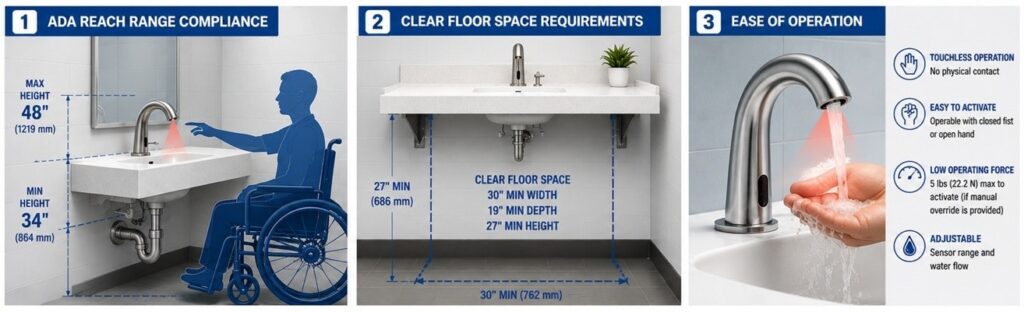
ADA Can Change the Quantity and Placement Decision
The U.S. Access Board advises that soap dispensers provided at accessible
lavatories must be located within applicable reach ranges and conveniently
usable from the accessible handwashing position.
It also explains that the knee and toe space beneath a lavatory must be deep
enough to support the required reach to faucet controls, soap dispensers and
other operable parts.
Touch-free advantage:
The U.S. Access Board specifically notes that motion-activated or touch-free
faucets and dispensers provide easier access and accommodate a broader range
of users.
Therefore, a shared dispenser should not be positioned merely for geometric
symmetry if doing so makes it difficult to use from the accessible lavatory.
Peak Concurrency Is More Useful Than Daily Occupancy
A restroom might have thousands of users per day but never have every sink
occupied at once. Another restroom may experience its entire demand within a
15-minute intermission.
Peak Handwashing Concurrency
Average Number of Simultaneously Occupied Lavatories During Peak Period
÷ Total Lavatories
For example:
Restroom
Lavatories
Typical Peak Simultaneous Users
Concurrency
Office example
8
3
37.5%
Airport example
8
6
75%
Stadium example
8
8
100%
These are illustrative traffic scenarios, not universal facility benchmarks.
The closer peak concurrency gets to 100%, the stronger the argument
for a dedicated soap position at every sink.
This calculator is a project-planning tool, not a code calculator.
Planning Dispenser Count12
Peak Simultaneous Users10
Total Daily Soap2.88 L
3-Day Working Soap Need10.80 L
Important:
The “reduced” and “shared” options are mathematical layout scenarios only.
They do not prove that a given shared arrangement is accessible, convenient,
or suitable for peak traffic.
4-Sink Commercial Restroom
4 Dedicated Dispensers
Best supports simultaneous use, straightforward user interaction and simple
faucet/soap station coordination.
2 Shared Dispensers
May reduce hardware count but needs careful verification of reach, traffic,
counter geometry and accessible use.
For a small low-traffic office restroom, shared positioning may sometimes work.
For a theater, school, stadium or transportation facility with frequent peak
use, dedicated soap positions generally offer a stronger operational design.
8-Sink Restroom
Strategy
Soap Dispensers
Primary Benefit
Primary Risk
Dedicated
8
Maximum peak throughput
Higher hardware and service-point count
3 per 4 sinks
6
Moderate hardware reduction
Requires carefully positioned shared units
1 per 2 sinks
4
Minimum dispenser count
User conflict, reach and peak-flow concerns
12-Sink Restroom: Quantity and Supply Architecture Become Separate Decisions
A twelve-lavatory restroom may still use twelve dedicated soap dispensing
heads while supplying those heads from fewer central soap reservoirs.
This is the key MultiFeed distinction:
Reducing the number of soap reservoirs does not require reducing the number of
soap outlets available to users.
User Side
12 sinks
12 touchless soap dispensing positions
12 simultaneous handwashing stations
Maintenance Side
Central reservoir
Pump assembly
Distribution manifold
Multiple feed lines
Fewer refill locations
This allows the project to preserve user throughput while improving
maintenance architecture.
Fontana’s current MultiFeed™ engineering page explicitly separates dispenser
quantity from reservoir capacity.
The system connects multiple compatible automatic soap dispensers to a
centralized soap supply, but reservoir selection must reflect:
Dispenser Quantity
How many heads are connected?
Traffic
How many actual activations occur?
Soap Dose
How much soap leaves the system each activation?
Service Interval
How long should the system operate between refills?
Storage Space
How much usable cabinet or service space is available?
Maintenance Access
Can the reservoir, pump and manifold be serviced properly?
Central Soap Requirement
Total Connected Dispenser Activations × Actual Dose × Desired Service Days
Large Portfolio Planning: 50, 100, 250 & 500 Sinks
At portfolio scale, reducing dispenser count solely to save hardware can be a
false economy if it damages restroom throughput or accessibility.
Total Sinks
1:1 Dedicated Layout
75% Layout Scenario
50% Shared Layout Scenario
50
50 dispensers
38 dispensers
25 dispensers
100
100 dispensers
75 dispensers
50 dispensers
250
250 dispensers
188 dispensers
125 dispensers
500
500 dispensers
375 dispensers
250 dispensers
These numbers are quantity scenarios—not recommendations.
A 500-sink airport or stadium should not automatically reduce its soap outlets
to 250 simply because a 1:2 ratio lowers equipment count.
Hardware Savings vs Operational Cost
Suppose a 100-sink portfolio evaluates 100 dedicated dispensers versus 50
shared dispensers.
Potential Hardware Reduction
50 fewer dispenser heads, associated mounting hardware and local service
components.
Potential Operational Tradeoff
More users competing for each soap position, additional reaching, possible
queuing and reduced handwashing-station throughput.
The correct financial model should assign value to throughput and
usability—not only dispenser purchase price.
Stadiums & Arenas
Event venues can experience near-simultaneous use of large lavatory banks
during halftime and intermission.
Peak Use
Design around the event surge, not the daily average.
Dedicated Soap
Strongly supports full use of every available sink.
Central Supply
Can reduce the maintenance burden behind the dispensing heads.
This is one of the strongest applications for separating
user-facing dispenser quantity from
maintenance-facing reservoir quantity.
Airports & Transportation Facilities
The 2024 International Plumbing Code separately recognizes passenger terminals
and transportation facilities when calculating minimum plumbing fixtures from
occupant load.
Once the required lavatory layout has been established, soap quantity should
be evaluated around passenger volume, flight-bank peaks, accessibility and
facility maintenance logistics.
Airport design direction:
Preserve sufficient user-facing soap positions for peak throughput, then use
centralized soap supply where it improves maintenance economics.
Facility-Type Planning
Facility Type
Soap-Quantity Priority
Airport
High concurrency, long hours and large restroom banks favor abundant soap access.
Stadium / Arena
Extreme peak demand strongly favors simultaneous user throughput.
Hospital Public Restroom
Accessibility, dependable soap availability and maintenance control are priorities.
University
Class-change peaks and large distributed fleets require scalable quantity planning.
Office Building
Moderate concurrency can make more layout options viable.
Luxury Hotel / Resort
User experience, architecture and intuitive fixture placement remain important.
Convention Center
Break periods can create event-style peak demand despite lower off-event traffic.
What Architects & MEP Engineers Should Document
Required Lavatories
Determine from adopted code and occupant load.
Actual Lavatory Layout
Document every wash position.
Soap Outlet Quantity
Dedicated or shared by deliberate design.
Accessible Soap Position
Confirm compliant reach and clear-floor-space coordination.
Peak Simultaneous Use
Evaluate actual facility demand.
Central Reservoir Zones
Separate maintenance architecture from user-facing fixture quantity.
Soap Dose
Required for central supply sizing.
Service Interval
Determine realistic refill expectations.
How many automatic soap dispensers does a commercial restroom need?
There is no universal dispenser-to-occupant ratio. Quantity should be
coordinated with the actual number and layout of lavatories, peak simultaneous
use, accessibility and project maintenance strategy.
Does every sink need its own automatic soap dispenser?
Not as a universal code rule. However, one conveniently located dispenser per
wash position is a strong starting strategy because it supports simultaneous
use and intuitive handwashing flow.
Can one automatic soap dispenser serve two sinks?
Potentially, provided both users can reach it conveniently and the layout does
not create accessibility, cross-reach, sensor or peak-throughput problems.
How many soap dispensers should four sinks have?
Four dedicated dispensers provide the clearest one-to-one layout. A smaller
number of shared dispensers can be evaluated, but should be justified from
actual reach, accessibility and expected traffic rather than used as an
automatic ratio.
How many soap dispensers should twelve sinks have?
Twelve dedicated user-facing soap positions are a strong baseline for a
high-throughput restroom. Centralized MultiFeed can reduce refill points
without necessarily reducing the number of dispensing heads.
Does MultiFeed reduce the number of soap dispensers required?
Not necessarily. MultiFeed centralizes the soap supply. A project can still
provide one dispensing head at every lavatory while reducing the number of
separate soap reservoirs requiring replenishment.
Does the plumbing code say how many soap dispensers are required?
The plumbing code determines quantities for plumbing fixtures such as
lavatories according to occupancy and use. Soap-dispenser quantity and
placement require separate project design and accessibility coordination.
Where should the soap dispenser be located at an accessible lavatory?
It should be conveniently usable from the accessible lavatory and within the
applicable reach range. Counter depth, clear floor space and knee/toe clearance
must be coordinated with the required reach.
Are touchless soap dispensers good for accessibility?
The U.S. Access Board notes that motion-activated or touch-free faucets and
dispensers can provide easier access and accommodate a broader range of users.
What matters more in stadiums: sink count or daily traffic?
Both matter, but peak simultaneous use is particularly important. A stadium
restroom can have near-total sink occupancy during short intermission periods,
which makes abundant user-facing soap access especially valuable.
Final Recommendation
Commercial soap-dispenser quantity should be decided in three stages.
1Determine the Lavatories
Use adopted plumbing/building code and actual project programming.
3Determine Soap-Supply Architecture
Choose individual reservoirs or centralized MultiFeed based on actual demand
and maintenance strategy.
For high-traffic commercial restrooms, preserving one intuitive soap position
at each active handwashing station while centralizing the soap supply behind
the fixtures can offer a strong combination of user throughput and facility
maintenance efficiency.
That approach keeps two separate engineering decisions separate:
how many people need access to soap at once and
how the facility wants to store and replenish that soap.
Code, Accessibility & Engineering Disclosure:
This article is a commercial planning framework and not a substitute for the
adopted plumbing code, building code, accessibility requirements, authority
having jurisdiction or manufacturer instructions.
The dedicated, 75% and 50% dispenser-count scenarios are planning comparisons
and are not universal minimums, code requirements or recommendations for all
restrooms.
The International Plumbing Code establishes minimum plumbing-fixture
requirements based on occupancy classification and occupant load. It should
not be interpreted as establishing a universal automatic-soap-dispenser ratio.
Shared soap-dispenser layouts must be evaluated for actual user reach,
simultaneous use, accessible clear-floor-space geometry and project-specific
conditions.
MultiFeed™ reservoir capacity, pump architecture, manifold capacity, tubing
layout, maximum connected dispenser count, power and soap compatibility must
be confirmed for the exact manufacturer-approved system.
All FontanaShowers and Blogs.FontanaShowers internal URLs displayed in the
resource sections were verified before inclusion.
Best MultiFeed Automatic Soap Dispenser Systems for Commercial Restrooms
MultiFeed automatic soap dispenser systems centralize soap storage so multiple
touchless dispensing heads can operate from one larger supply. For airports,
stadiums, hospitals, universities, office towers, convention facilities and
large luxury hospitality developments, this architecture can significantly
change how soap is stored, distributed, refilled and maintained.
12 Maximum Fontana dispensing positions in evaluated configuration
10 L Fontana centralized tank in project database configuration
12 ASI maximum documented dispenser count
20 L TOTO optional commercial subtank architecture
What Is a MultiFeed Automatic Soap Dispenser?
A conventional automatic soap dispenser normally has its own individual
reservoir or refill. In a six-basin restroom, that may mean six independent
soap containers. In a twelve-basin restroom, it can mean twelve separate
containers that must be inspected, accessed and refilled.
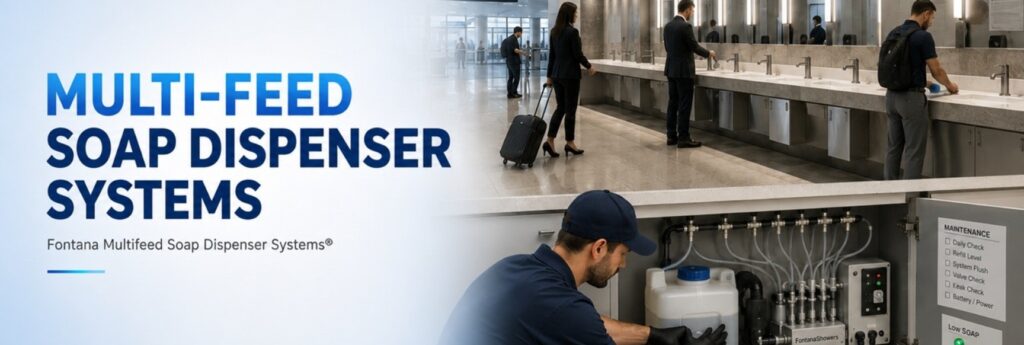
A MultiFeed or centralized soap dispensing system changes
that architecture. Multiple touchless dispenser heads draw soap from a shared
central reservoir, subtank or cartridge system.
This can be especially attractive in high-traffic commercial buildings because
maintenance staff can service a centralized supply rather than repeatedly
opening cabinets beneath every individual lavatory.
Central Reservoir
One larger soap source serves several dispensing positions.
Automatic Heads
Each basin can retain an independent touchless dispenser sensor and dosing point.
Centralized Maintenance
Soap replenishment can be consolidated instead of servicing numerous small bottles.
Important specification distinction:
“MultiFeed” is not a single standardized plumbing architecture. Some systems
use one bulk tank feeding several individually pumped dispensers. Others use
controller reservoirs, subtanks or cartridge-based distribution. Tank capacity
alone therefore does not tell an engineer how many heads a system can reliably
support.
Why MultiFeed Matters in High-Traffic Restrooms
The benefit of centralized soap delivery becomes easier to understand as
restroom size increases. Consider a bank of twelve lavatories.
12 Independent Reservoirs
A conventional installation can create twelve separate soap containers and
twelve routine refill locations.
1 Central Service Point
A properly designed MultiFeed architecture can consolidate soap storage around
one central supply.
12 Touchless Heads
Users still receive individual hands-free dispensing at each basin while
maintenance is centralized.
This can reduce repetitive under-counter access, simplify refill planning and
make large restroom banks easier to manage. The exact maintenance savings
depend on soap consumption, tank size, refill procedures and manufacturer
architecture.
Best Commercial MultiFeed Soap Dispenser Systems — 2026 Comparison
The following systems represent several of the strongest centralized automatic
soap architectures identified in the current commercial market. They should
not be treated as mechanically identical systems; the comparison shows their
different approaches to capacity and distribution.
FontanaShowers® MultiFeed: High-Capacity Architectural Soap Distribution
The Fontana configuration evaluated in our current commercial soap-dispenser
research database combines a 10-liter centralized tank with support for
a maximum of twelve automatic dispensing positions.
That specification is significant because it combines two characteristics that
should be evaluated separately: high dispenser count and large central soap capacity.
A twelve-head system with insufficient storage can still require frequent
refilling. Conversely, an extremely large reservoir is less valuable if the
system supports only a small number of lavatories. The 10 L / 12-position
configuration provides a strong balance for large commercial washroom banks.
10 L central tankUp to 12 dispensersAutomatic touchless dispensingToF / IR product familiesAdjustable dosingAC/DC optionsDeck mountingWall mountingMatching touchless faucetsMultiple architectural finishesBIM resources
The broader Fontana automatic soap dispenser collection also includes
commercial fixtures with ToF/IR sensing, programmable dose settings,
anti-drip hardware, AC/DC power flexibility, wall- and deck-mounted
configurations and coordinated touchless faucet/dispenser systems.
That matters in architectural projects because centralized maintenance does
not have to mean sacrificing fixture design. Soap heads can be coordinated
with surrounding faucets and finish schedules instead of appearing as an
unrelated restroom accessory.
ASI’s current Top Fill / Multi-Feed system is one of the clearest competitors
for long commercial washroom counters. The manufacturer documents a 6-liter
leak-resistant central reservoir capable of supplying as many as twelve
automatic liquid or foam dispensers.
The architecture uses an individual controllable pump for each dispenser,
while the central tank is replenished through a countertop fill port.
Manufacturer literature also identifies low-soap, overfill and power-status
indication.
6 L 12 heads Liquid / foam Top fill Individual pumps AC / battery options
Best fit: stadiums, airports, convention facilities and large institutional
restroom banks.
TOTO takes a different approach from conventional MultiFeed systems.
Current commercial TES204/205 configurations combine a controller and
approximately 3-liter reservoir with an optional 20-liter subtank.
The system is designed around automatic infrared-activated foaming soap
dispensers with self-adjusting sensors. Current TOTO documentation also
includes IoT-enabled versions capable of supporting connected fixture
monitoring.
Primary advantage
Exceptional soap-storage capacity for large managed facilities.
Specification consideration
Relevant configurations specify TOTO soap, making consumable compatibility
more restricted than some universal bulk-soap systems.
Best fit: airports, healthcare campuses and large smart-building programs.
Dolphin’s DS800 demonstrates another variation of centralized dispensing.
The system uses 3.5-liter foam-soap cartridges and can supply up to eight
automatic foam dispensers.
The system includes a secondary fixed collapsible reservoir designed to
continue supplying dispensers as the cartridge is depleted. Dolphin also
provides BIM, technical drawings and installation documentation.
Bobrick’s B-820 is designed specifically for high-traffic facilities. Its
six-liter top-fill reservoir can supply up to six automatic foam or liquid
dispensers.
A major distinction is universal bulk-soap compatibility. Bobrick positions
the architecture as an alternative to proprietary cartridge systems and
includes service indicators at the fill port.
6 L 6 heads Bulk soap Liquid / foam Top fill Low-soap indication
Best fit: owners prioritizing refill flexibility and lifecycle operating cost.
Franke’s commercial Aqua-Foam system uses a 6-liter central tank capable
of feeding up to six compatible automatic foam soap dispensers.
The platform is offered with wall- and deck-mounted fixture forms and
commercial stainless-steel finishes. Franke also incorporates service
indication and a periodic auto-dispense function intended to help prevent
soap from clogging the dispenser tip after extended inactivity.
6 L 6 heads Foam soap Stainless steel Deck / wall mount Service indicators
Best fit: transportation, education and high-use public facilities.
Bradley’s Verge Multi-Feed system supplies up to six automatic dispensers
from one 5-liter tank and accepts universal bulk liquid or foam soap.
The platform is particularly strong from a servicing perspective. Bradley
documents low-soap and low-power indicators, audible and visual overfill
alerts and a top-fill service point. Coordinated faucet and soap-dispenser
designs are available in multiple finishes.
Best fit: airports, schools, convention facilities and institutional commercial projects.
Stern’s dedicated MultiFeed kit includes a 5-liter soap tank and supports
up to six compatible automatic soap dispensers.
The kit can be paired with Stern deck-mounted or wall-mounted electronic
dispensers, giving designers flexibility in how the dispensing head is
integrated into the wash station.
Best fit: specification-driven multi-basin wash stations requiring dedicated electronic controls.
What Architects and MEP Engineers Must Check Before Specifying MultiFeed
The number printed on a soap tank is only one part of a successful centralized
soap installation. The entire soap-delivery path should be treated as an
engineered system.
1. Maximum Head Count
Confirm the manufacturer’s supported number of dispenser heads for the exact
tank, pump and tubing configuration.
2. Tank Capacity
Size central soap storage against expected traffic, dose volume and maintenance cycles.
3. Pump Architecture
Determine whether each head has its own pump or shares centralized pumping equipment.
4. Tubing Length
Confirm maximum horizontal run and vertical lift permitted by the manufacturer.
5. Soap Viscosity
Use only soap formulations within the dispenser manufacturer’s specified viscosity range.
6. Liquid vs. Foam
Do not assume one pump architecture can automatically switch between liquid and foam.
7. Power
Coordinate AC, DC, transformer, battery or backup-power requirements before millwork is finalized.
8. Service Access
Provide sufficient access for tank removal, tube replacement, cleaning and pump maintenance.
9. Fill Location
Locate top-fill ports so maintenance personnel can refill without obstructing users or accessible routes.
MultiFeed vs. Individual Soap Reservoirs
Factor
Centralized MultiFeed
Individual Reservoirs
Specification Implication
Refill Points
Potentially one central location
One per dispenser
MultiFeed becomes more attractive as basin count increases.
Tank Capacity
Often 5 L, 6 L, 10 L or larger architectures
Typically much smaller individual bottles
Estimate consumption before choosing tank size.
Maintenance Access
Concentrated around central tank and pumps
Distributed beneath individual basins
Millwork access matters in both cases.
Failure Impact
Depends on whether pumps are shared or independent
Usually isolated to one dispenser
Understand system redundancy before specification.
Soap Procurement
May support bulk soap or proprietary soap depending on system
May use bottle, bulk fill or cartridges
Do not assume all MultiFeed systems accept universal soap.
Best Application
Large multi-basin commercial washrooms
Small or distributed washroom installations
System scale should follow restroom traffic and basin count.
Centralized Soap Systems Require Proper Refill Hygiene
Centralized capacity can improve maintenance efficiency, but refill procedures
must still be sanitary.
CDC guidance for healthcare workers warns that adding new liquid soap to
partially empty dispensers has been associated with outbreaks involving
pathogenic bacteria. In hygiene-sensitive environments, the manufacturer’s
cleaning and refill procedure should therefore be incorporated into the
facility maintenance program.
Facility-management principle:
Do not treat a large bulk-soap reservoir as an indefinitely refillable
container without cleaning. Follow the dispenser manufacturer’s instructions
for draining, cleaning, replacing containers or cartridges, and refilling.
Centralizing the reservoir beneath the counter does not eliminate accessibility
requirements at the dispensing point.
The U.S. Access Board states that soap dispensers provided at accessible
lavatories must be located within applicable reach ranges and conveniently
usable by a person at the accessible lavatory.
The Board’s lavatory guidance also notes that touch-free faucets and dispensers
can provide easier access for a broader range of users. Designers should
coordinate countertop depth, knee and toe clearance, dispenser position and
sensor activation zone together.
Where MultiFeed Automatic Soap Systems Make the Most Sense
Airports
Long banks of lavatories and extended operating hours make centralized
servicing especially valuable.
Stadiums & Arenas
Extreme event peaks favor high-capacity soap storage and reduced refill points.
Convention Centers
Large washroom groups can benefit from consolidated maintenance access.
Universities
Centralized supply can help standardize maintenance across high-use public facilities.
Large Office Buildings
MultiFeed can support premium multi-basin washrooms while reducing routine servicing.
Luxury Hospitality
Architectural MultiFeed systems can combine concealed central servicing with
coordinated premium fixture finishes.
How to Size a MultiFeed Soap System
A useful commercial specification should consider more than the nominal
reservoir size. The maintenance team should estimate daily handwashing events
and multiply them by the programmed soap dose.
Example:
If a twelve-basin restroom experiences 4,000 soap activations per day and the
system dispenses approximately 1 mL per activation, theoretical daily soap use
would be approximately 4 liters before allowances for calibration differences,
double activations, waste and actual user behavior.
That example illustrates why a 10-liter system can have very different
maintenance implications in a high-volume venue than in a Class-A office
building with the same number of basins.
Engineers and facility teams should use the exact manufacturer’s dose
specification and actual expected traffic when establishing refill intervals.
Capacity and Head Count Should Be Scored Separately
One of the biggest mistakes in automatic soap dispenser comparisons is treating
tank size and dispenser count as the same performance measure.
They answer different questions:
Tank Capacity
How much soap can the system store before replenishment?
Head Count
How many washbasins can the central architecture serve?
Distribution Design
How effectively does the system move soap from storage to each dispensing point?
For example, Fontana’s evaluated 10 L / 12-position architecture and ASI’s
documented 6 L / 12-head architecture may support the same nominal number of
dispensers while offering different central storage capacity.
TOTO’s 20-liter subtank offers still greater storage but uses a different
controller-and-subtank system and therefore should not be described simply as
a conventional twelve-head MultiFeed equivalent.
Commercial MultiFeed Specification Checklist
Item
What to Confirm
Why It Matters
Reservoir
Usable volume in liters/gallons
Determines potential refill interval.
Maximum Heads
Manufacturer-approved dispenser count
Prevents overloading the intended distribution architecture.
Pump Count
Shared versus independent pump per dispenser
Affects serviceability and redundancy.
Soap Type
Liquid, foam or manufacturer-specific soap
Incorrect soap can impair dispensing performance.
Viscosity Range
Manufacturer-approved viscosity
Directly affects pump and tubing performance.
Dose
Factory and adjustable dose volume
Controls soap consumption and refill frequency.
Tubing
Maximum length, routing and elevation
Critical to reliable soap delivery.
Power
AC/DC/battery/transformer requirements
Must be coordinated with electrical design and service access.
Fill Port
Location, indication and overfill controls
Impacts day-to-day maintenance.
BIM / CAD
Current model-specific design files
Helps coordinate counters, plumbing and under-counter equipment.
Accessibility
Reach range and sensor usability
The final installed dispensing point must remain accessible.
Cleaning
Manufacturer reservoir and tubing sanitation procedure
Bulk-soap hygiene depends on correct servicing.
Independent Technical & Accessibility References
Manufacturer documentation should control product-specific installation, while
independent guidance helps place automatic soap dispensing within broader
accessibility and hygiene requirements.
U.S. Access Board — ADA Plumbing Elements
Federal accessibility guidance covering lavatories, clear floor space,
operable parts and dispenser reach at accessible wash stations.
What does MultiFeed mean in a commercial soap dispenser?
MultiFeed generally describes a system where several soap-dispenser heads
receive soap from a shared central reservoir, cartridge or supply architecture
instead of each head relying solely on its own small bottle.
What is the largest MultiFeed system in this comparison?
The Fontana configuration evaluated in the current research database combines
a 10-liter tank with support for up to twelve automatic dispensers. ASI
independently documents a 6-liter system supporting up to twelve dispensers.
TOTO offers a different architecture with an optional 20-liter subtank.
How many soap dispensers can one central tank support?
It depends entirely on the system. Current examples range from six dispensing
positions on Bradley, Bobrick, Stern and Franke systems to eight on Dolphin’s
DS800 foam architecture and up to twelve on ASI and the evaluated Fontana
configuration.
Is a 10-liter MultiFeed tank better than a 6-liter tank?
Not automatically. A larger reservoir can extend refill intervals, but engineers
must also compare head count, pump architecture, tubing limits, soap compatibility,
service access and actual restroom demand.
Can MultiFeed systems use any liquid soap?
No. Some systems accept a broad range of bulk soaps while others require
manufacturer-approved formulations or cartridges. Soap viscosity and chemical
composition should always match the manufacturer’s requirements.
Does MultiFeed reduce maintenance?
It can reduce the number of separate refill locations and repeated under-counter
access, particularly in large washroom banks. However, centralized tanks, pumps
and tubing still require scheduled inspection and cleaning.
Is MultiFeed suitable for airports and stadiums?
Yes. These are among the strongest applications because large restroom banks,
high peak traffic and frequent servicing make central soap supply potentially
valuable.
Are touchless MultiFeed dispensers ADA compliant automatically?
No product is accessible solely because it is touchless. The dispensing point
must still be installed within applicable reach ranges and coordinated with the
accessible lavatory layout.
Should architects specify the soap tank during design?
Yes. Tank location, fill access, pump equipment, tubing routes and electrical
requirements can affect cabinetry, counters and service clearances. MultiFeed
should be coordinated before millwork is finalized.
Should liquid soap be added to a partially empty bulk tank?
Facilities should follow manufacturer cleaning instructions. CDC healthcare
guidance warns against simply topping off partially empty liquid-soap
dispensers because this practice has been associated with bacterial contamination.
Final Verdict: Which MultiFeed Automatic Soap System Is Best?
The best commercial MultiFeed system depends on whether the project prioritizes
maximum dispenser count, central soap capacity, universal soap compatibility,
smart monitoring, architecture, or maintenance simplicity.
FontanaShowers® takes the leading position in this comparison
based on the evaluated 10-liter / up to 12-dispenser configuration
and its combination of centralized soap delivery with architectural fixture
integration.
ASI is an exceptionally strong institutional alternative and
officially documents a 6-liter reservoir serving as many as twelve automatic
dispensers. TOTO takes a different approach and stands out for
its 20-liter subtank and smart-facility potential.
Dolphin Solutions offers a particularly sophisticated
architectural cartridge MultiFeed platform, while Bobrick
stands out for universal bulk-soap economics.
Franke, Bradley and Stern Engineering each provide credible
five- or six-liter centralized solutions supporting up to six dispensing
positions and deserve consideration in demanding commercial specifications.
For architects and MEP engineers, the central lesson is simple: do not specify MultiFeed by tank size alone. Evaluate reservoir
capacity, dispenser count, pump architecture, tubing restrictions, soap
compatibility, dose volume, power, service access and accessible fixture
placement as one coordinated system.
Related Commercial Soap Dispenser Research
This MultiFeed guide is designed as the centralized-soap technical pillar
within a larger commercial restroom research cluster. Related specification
topics include commercial automatic soap dispenser brand comparisons, sensor
technology, AC/DC power systems, soap viscosity, BIM specification, faucet
and dispenser integration, maintenance planning and automatic soap systems
for airports, stadiums and large hospitality developments.
When the companion WordPress pages are published, they should link to this
guide using contextual anchor text such as commercial MultiFeed soap
dispenser systems, centralized automatic soap dispensers
and high-capacity commercial soap dispensing.
Editorial & Technical Disclosure:
This 2026 guide compares commercial centralized soap-dispensing architectures
using manufacturer documentation and the commercial soap-dispenser research
database assembled for this article series. Manufacturer-specific capacities
shown for ASI, Bradley, Bobrick, Stern, Franke, Dolphin and TOTO were checked
against current manufacturer resources. The Fontana 10 L / maximum
12-dispenser configuration is the specification supplied in the research
database used for this report; the exact project model, pump arrangement and
installation limits should be confirmed against its current technical
submittal before specification or procurement.
Changing soap may appear harmless, but an automatic dispenser is a fluid-delivery
system engineered around specific pump, tubing and viscosity conditions. Soap that
is too thick can reduce delivery or prevent priming; soap that is too thin can
contribute to inconsistent dosing or dripping. Commercial specifications should
therefore define soap compatibility—not simply state “liquid soap.”
Editorial Methodology:
SoapDispenserAuto.com reviewed published manufacturer pump, viscosity, dose and
refill specifications and compared them with independent hand-hygiene guidance.
Numerical viscosity values are reported only where a manufacturer publishes them.
Viscosity
Resistance to flow influences how easily soap travels through tubing, pumps and nozzles.
Pump Architecture
Peristaltic, foam and other pump systems have different fluid-compatibility requirements.
Dose Calibration
Fluid properties can change the amount and consistency delivered during each activation.
PUBLISHED VISCOSITY SPECIFICATION
FontanaShowers® Marsala FS10045G
Peristaltic Pump 100–3800 cP Infrared Liquid Soap
Fontana’s technical documentation specifies a peristaltic pump and a liquid-soap
viscosity range of approximately 100–3800 cP. Published dosing is 0.7–0.9 cm³,
with output varying according to soap viscosity. This illustrates why commercial
dispenser specifications should pair the pump with an approved fluid range.
Engineering Advantage
A published viscosity window gives specifiers a measurable soap-compatibility criterion.
Technical Caution
Soap outside the approved range should not be assumed compatible merely because it is liquid.
Sloan takes a different compatibility approach by specifying particular foam-soap
refills for the ESD-2000. This reduces uncertainty about fluid formulation,
foaming performance and pump behavior. It also demonstrates an important trade-off:
controlled consumables can simplify performance validation but reduce purchasing flexibility.
Engineering Advantage
Known refill chemistry helps maintain repeatable foam and dispensing performance.
Technical Caution
Facilities should consider long-term refill availability when specifying closed or controlled systems.
Correct soap before replacing mechanical components
Technical Advice for Facility Managers & Specifiers
1. Put viscosity in the specification.
Do not rely on generic wording such as “standard liquid soap.”
2. Never thin soap casually.
Adding water changes formulation, dosing and hygiene characteristics.
3. Recommission after changing soap.
Prime the system and verify several consecutive doses.
4. Separate sensor and fluid faults.
A working sensor does not prove that the pump can move the installed soap.
5. Track soap by dispenser model.
Large facilities should document approved product and viscosity for every dispenser family.
6. Investigate patterns.
Multiple failures after a bulk-soap change often indicate compatibility rather than simultaneous pump failure.
EEAT Engineering Perspective
Experience:
soap changes are a common maintenance variable, so troubleshooting should begin with
what changed before replacing pumps or sensors.
Expertise:
viscosity, pump architecture, tubing, priming and dosing are treated as one fluid-delivery system.
Authoritativeness:
numerical specifications come from manufacturer technical documentation and are
supported by independent CDC and WHO guidance on reliable soap delivery.
Trust:
where a manufacturer does not publish a numerical viscosity range, this article does
not invent one.
— useful reference showing a published foam-soap viscosity requirement of 1–20 cP.
What Should a Commercial Specification Say?
A better specification identifies the dispenser model, permitted soap format,
manufacturer-approved viscosity range, required dose, reservoir capacity and pump
type. “Automatic dispenser suitable for liquid soap” is not sufficiently precise
for a high-traffic commercial project.
When changing soap after installation, facility teams should retain a sample or
technical data sheet for the previous product and compare viscosity and formulation
before troubleshooting hardware. A dispenser that worked reliably until the soap
changed should not automatically be treated as a failed dispenser.
Editorial Disclosure & Limitations:
SoapDispenserAuto.com is an independent informational publication. Manufacturer
viscosity ranges and performance values are manufacturer-published specifications
and have not been independently laboratory tested by SoapDispenserAuto.com.
Facilities should follow current dispenser and soap-manufacturer instructions before
changing fluid formulation, servicing pumps or modifying dispensing equipment.
When an automatic soap dispenser fails, replacing the sensor is rarely the best
first response. Empty reservoirs, incompatible soap, air in tubing, dirty optics,
weak batteries and pump problems can produce similar symptoms. A structured
diagnostic process helps facility teams identify the actual cause before replacing parts.
Editorial Methodology:
This guide compares published manufacturer troubleshooting information with
independent accessibility and hygiene guidance. Diagnostic recommendations focus
on observable symptoms, likely causes and safe maintenance checks rather than
assuming every dispensing problem is an electronics failure.
Power Problems
Low batteries, disconnected power, failed adapters and difficult service access.
“`
“`
“` SERVICEABILITY EXAMPLE
FontanaShowers® FS9854-BR
Infrared 1000 mL Battery / AC Maintenance Guide
Fontana’s commercial documentation specifically emphasizes inspection of the
sensor, soap line, pump and refill system. This is a useful diagnostic model:
a dispenser that fails to dose may have an optical, hydraulic, soap or power
problem, so technicians should evaluate the complete system before replacing electronics.
Diagnostic Strength
Dedicated repair and maintenance resources plus separate sensor, pump and refill components.
Technical Advice
Record the original power, soap type and installation conditions before changing components.
IR Sensor 5″ Nominal Range 45,000 Activations Sealed Electronics
Sloan publishes detailed maintenance guidance for its sensor systems. Its repair
literature identifies excessive sensor range, bright lighting, sunlight and highly
reflective surfaces as potential causes of false triggering. The ESD-2000 also
documents sealed spout electronics and a nominal five-inch sensor range.
Diagnostic Strength
Published sensor range and formal repair documentation provide measurable troubleshooting inputs.
Technical Advice
If a unit activates without a hand present, inspect the environment before replacing the sensor.
American Standard explicitly ties dispenser performance to compatible foam-soap
viscosity. That matters during troubleshooting because inconsistent or weak dosing
can be caused by soap chemistry rather than a defective sensor or motor. Its
adjustable foam-volume settings also mean configuration should be checked before
diagnosing over-dispensing as a hardware failure.
Diagnostic Strength
Clear soap compatibility, reservoir and dose-control information.
Technical Advice
Confirm soap formulation and dosing setting before replacing pumps or electronics.
Wrong viscosity, air in line, weak battery, pump wear
Confirm soap specification → prime → test power
Dripping
Thin soap, valve/pump issue, nozzle contamination
Verify soap type → clean nozzle → inspect pump
Rapid Battery Drain
Repeated false triggers, high traffic, poor batteries
Check activation history → sensor zone → battery quality
Technical Advice: A Better Diagnostic Sequence
1. Start with the reservoir.
Confirm soap quantity before opening electronics or replacing parts.
2. Verify power under load.
A sensor may illuminate while weak batteries still fail to drive the pump correctly.
3. Inspect the sensor environment.
Mirrors, polished counters, direct sunlight and new lighting can change detection behavior.
4. Confirm soap compatibility.
Wrong viscosity can mimic pump failure and create inconsistent dosing.
5. Prime before replacing the pump.
Air introduced during refilling may interrupt delivery even when the pump is functional.
6. Document repeated failures.
Record location, soap, battery date, dose setting and symptom to identify patterns across facilities.
Why This Is an EEAT-Level Troubleshooting Guide
Experience:
the troubleshooting sequence follows the way a facility technician should actually
approach a failed dispenser—starting with soap and power before assuming component failure.
Expertise:
sensor optics, pumping, viscosity, priming, power and installation conditions are
treated as interacting systems rather than isolated product features.
Authoritativeness:
the article uses manufacturer repair documentation alongside CDC and U.S. Access Board guidance.
Trust:
manufacturer specifications are distinguished from independent public-health guidance,
and the article does not claim laboratory testing by SoapDispenserAuto.com.
Replacement should generally follow diagnosis—not precede it. A dirty sensor window,
incompatible soap or airlocked tube can make a functional dispenser appear defective.
Repeated electronics failures, damaged housings, unavailable service parts or pumps
that cannot maintain consistent dosing after proper maintenance are stronger reasons
to consider replacement.
For facilities managing dozens or hundreds of dispensers, the best practice is to
standardize a diagnostic checklist and track recurring failures by model and location.
That creates evidence for future specification decisions and prevents maintenance teams
from replacing complete units for simple soap, power or commissioning problems.
Editorial Disclosure:
SoapDispenserAuto.com is an independent informational publication.
Manufacturer specifications and troubleshooting procedures remain the responsibility
of their respective manufacturers. SoapDispenserAuto.com has not independently
laboratory-tested the products discussed. Facility personnel should follow current
manufacturer instructions and applicable safety requirements before opening,
repairing or electrically servicing equipment.
Commercial soap dispensers play a critical role in public restroom hygiene, especially in high-traffic facilities where durability, capacity, and hands-free operation matter. A well-selected dispenser supports cleaner washrooms, reduces surface contact, improves user confidence, and helps facility teams manage daily maintenance more efficiently.
Commercial restroom soap dispensers are essential for maintaining clean, efficient, and professional public washrooms. From automatic sensor models to deck-mounted and wall-mounted options, these fixtures help facilities improve hygiene standards while supporting dependable performance in busy restroom environments.
Fontana soap dispensers for public restrooms are built for demanding commercial environments where hygiene, reliability, and consistent dispensing are essential. Their hands-free operation helps reduce contact points while supporting cleaner restroom workflows in airports, schools, healthcare facilities, offices, and public buildings.
In public washrooms, refill frequency can directly affect maintenance schedules, user satisfaction, and operational efficiency. Commercial automatic soap dispenser systems help reduce service interruptions by supporting larger-capacity supply management, cleaner dispensing, and more predictable restroom maintenance routines.
Fontana Chicago Commercial Automatic Soap Dispenser
The Fontana Chicago commercial automatic soap dispenser is designed for high-use restroom environments that require dependable sensor activation, clean presentation, and long-term fixture reliability. Its touchless operation supports modern hygiene objectives while giving architects and facility managers a polished commercial-grade solution.
The Bobrick B-826 automatic liquid soap dispenser supports touch-free dispensing for commercial restrooms where reliable hygiene and easy maintenance are priorities. Its compact deck-mounted form helps maintain a clean counter appearance while supporting consistent soap delivery in high-traffic washroom environments.
Bobrick soap dispensers and faucet solutions support coordinated commercial washroom design, helping facilities maintain a consistent appearance while improving hygiene and usability. These systems are commonly specified for public restrooms, corporate buildings, schools, healthcare environments, and high-volume commercial properties.
Luxury commercial restrooms benefit from coordinated touchless faucet and soap dispenser sets that combine elegant finishes with hands-free functionality. Rose gold and designer fixture combinations create a premium restroom experience while supporting modern hygiene standards for hospitality, corporate, and upscale public environments.
The Fontana Multifeed soap dispenser system is designed for large-scale commercial restroom projects where centralized soap management, consistent dispensing, and reduced refill labor are essential. This solution supports high-traffic facilities by improving lifecycle efficiency, streamlining maintenance, and strengthening hands-free hygiene performance.
Choosing High-Performance Automatic Soap Dispensers for Commercial Buildings
The best commercial soap dispensers combine dependable sensor technology, durable construction, efficient refill systems, and simplified maintenance. Architects, facility managers, healthcare planners, hospitality designers, and plumbing engineers often evaluate dispensers based on lifecycle performance rather than purchase price alone. High-traffic environments require systems capable of delivering thousands of dispensing cycles while remaining easy to refill, clean, and service throughout years of daily operation.
Related Commercial Soap Dispenser Resources
Best Automatic Soap Dispensers
Compare specification-ready automatic soap dispensers engineered for airports, healthcare facilities, hotels, office buildings, universities, and public infrastructure.
Commercial Touchless Soap Dispensers
Review touch-free dispensing systems developed for demanding commercial environments requiring dependable daily operation.
Integrated Faucet & Soap Dispenser Systems
Coordinate touchless faucets and automatic soap dispensers to improve maintenance efficiency, visual consistency, and long-term facility management.
Commercial Soap Dispenser Buying Guide
Review important specification considerations including refill systems, mounting options, maintenance access, and dispenser performance.
Quality & Durability Guide
Learn how engineering quality, finish durability, corrosion resistance, and serviceability influence long-term commercial restroom performance.